
Executive Summary: Why Precision E-Beam Dose Determination Matters
In modern medical device manufacturing, transitioning to or validating Electron Beam (E-Beam) radiation requires rigorous scientific dose setting. Unlike continuous gamma radiation ($Co^{60}$), E-Beam delivers concentrated electron pulses at ultra-high dose rates ($10^3 \text{ to } 10^6 \text{ Gy/s}$). Establishing the minimum dose required to achieve a Sterility Assurance Level (SAL) of 10⁻⁶ without exceeding the material’s Maximum Tolerable Dose ($D_{max,spec}$) demands precise bioburden characterization, accurate verification dose calculations, and dosimetry calibration under ISO 11137-2. This guide addresses the exact technical, procurement, and regulatory requirements engineered by C.G. Laboratories, Inc.
1. Fundamental Principles of E-Beam Dose Determination
E-Beam Dose Determination is the quantitative laboratory process used to establish the minimum absorbed radiation dose necessary to render a batch of medical devices sterile under ISO 11137-2 guidelines. Absorbed dose is measured in Kilograys (kGy), where $1 \text{ kGy} = 1 \text{ kJ/kg}$ of absorbed ionizing energy.
When high-energy electrons (typically accelerated between $3 \text{ MeV}$ and $10 \text{ MeV}$) strike a medical device, they generate secondary electron cascades that induce radiolytic cleavage of microbial DNA and RNA strands. Because the energy deposition occurs in micro-seconds, the biological microbial kill kinetics differ subtly from low-dose-rate gamma irradiation.
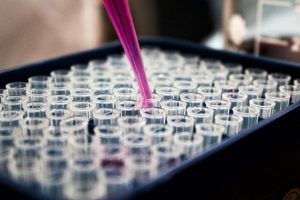
Biophysical Interaction Dynamics
The short exposure duration minimizes free radical migration in atmospheric oxygen, reducing oxidative polymer chain scission. However, to maximize this material benefit, the minimum sterilizing dose ($D_{ster}$) must be determined with clinical precision. Over-dosing causes yellowing, embrittlement, or toxic byproduct leaching; under-dosing risks non-sterility and regulatory rejection.
To balance material preservation and microbiological kill, ISO 11137-2 establishes standardized dose setting pathways based on the pre-sterilization bioburden population and its resistance profile ($D_{10}$ value).
2. Standardized ISO 11137-2 Dose Setting Protocols Explained
Global regulatory bodies (FDA, EMA, NMPA, PMDA) require manufacturers to select a validated dose setting protocol matching their product's bioburden load, batch variability, and production scale.
2.1 ISO 11137-2 Method 1: Bioburden-Based Dose Setting
Method 1 requires establishing the average bioburden across multiple production lots (minimum 3 lots, 10 units per lot) and determining the microbial population's radiation resistance via a Verification Dose Experiment ($VD$).
- Bioburden Recovery Efficiency: The raw colony-forming unit (CFU) counts must be corrected using a validated recovery efficiency factor ($R$), established via repetitive recovery or direct inoculation methods (ISO 11737-1).
- Verification Dose Calculation: Using the corrected mean bioburden, reference tables in ISO 11137-2 yield the verification dose ($D^*$ or $VD$), designed to yield a nominal $SAL = 10^{-1}$.
- Sub-Lethal Inoculation & Fraction Negative Testing: 20 product units are irradiated at the verification dose ($\pm 10\%$) and subjected to individual sterility testing in Fluid Thioglycollate Medium (FTM) and Tryptic Soy Broth (TSB) for 14 days. If no more than 2 units demonstrate growth, the verification dose is confirmed, and the minimum sterilizing dose for $SAL 10^{-6}$ is established.
2.2 Method 2: Incremental Dose Method for High-Volume or Novel Devices
Method 2 (Method 2A and Method 2B) is utilized when the bioburden resistance profile is unknown or anticipated to exceed standard reference populations (such as Bacillus pumilus ATCC 27142). It involves irradiating multiple groups of product units across a series of incremental radiation doses (e.g., 2, 4, 6, 8, 10 kGy) to construct an empirical inactivation curve and derive the $D_{10}$ value directly from the product bioburden.
2.3 Method $VD_{max}$ ($VD_{max}^{25}$ and $VD_{max}^{15}$): The Industry Standard for Low Bioburden Devices
The $VD_{max}$ methods represent a streamlined approach for products with low, consistent bioburden levels. Rather than deriving a custom $D_{ster}$, these protocols validate a pre-selected minimum sterilizing dose:
- $VD_{max}^{25}$ Protocol: Validates a $25 \text{ kGy}$ minimum sterilizing dose. It requires a bioburden average $\le 1,000 \text{ CFU/unit}$. A verification dose (calculated to achieve $SAL 10^{-1}$) is administered to 10 product units. If 0 or 1 unit shows growth, $25 \text{ kGy}$ is validated.
- $VD_{max}^{15}$ Protocol: Validates a $15 \text{ kGy}$ minimum sterilizing dose for sensitive materials (such as tissue matrices, hydrogels, or biologics). It requires an average bioburden $\le 1.5 \text{ CFU/unit}$.
- Method SQ (Single Batch): Designed for clinical trial batches or small-scale custom implant production, utilizing reduced unit quantities while adhering to strict bioburden controls.
Comparative Protocol Decision Matrix for Procurement & QA Engineers
| Protocol Standard | Target Minimum Dose ($D_{ster}$) | Max Bioburden Limit | Sample Size (Lots × Units) | Primary Application / Polymer Suitability |
|---|---|---|---|---|
| ISO 11137-2 Method 1 | Custom derived (e.g., 14.2 to 32 kGy) | Up to 1,000,000 CFU | 3 Lots × 10 Units (Bioburden) + 20 Units (Verification) | High/variable bioburden devices, complex assemblies, multi-material kits. |
| Method $VD_{max}^{25}$ | Fixed 25 kGy | ≤ 1,000 CFU/unit | 3 Lots × 10 Units (Bioburden) + 10 Units (Verification) | Standard single-use plastic devices, catheters, surgical drapes, syringes. |
| Method $VD_{max}^{15}$ | Fixed 15 kGy | ≤ 1.5 CFU/unit | 3 Lots × 10 Units (Bioburden) + 10 Units (Verification) | Radiation-sensitive polymers, tissue grafts, hydrogels, drug-device combos. |
| Method SQ | Derived or pre-selected (15-25 kGy) | Strict limits based on selection | 1 Single Lot (10 Bioburden + 10 Verification) | Orphan drugs, clinical trial devices, high-cost custom implants. |
3. Technical Recommendations: Dosimetry Systems & Dose Mapping Strategies
Selecting the appropriate dosimetry system is critical during E-Beam Dose Determination to ensure that dose distribution maps ($D_{min}$ and $D_{max}$ points) accurately reflect physical reality.
Expert Recommendation: Selecting the Right Dosimetry System
Because Electron Beam processing involves high-gradient electron scattering, dose distribution inside a packaged box is non-uniform. C.G. Laboratories recommends three primary dosimeter classifications based on resolution and range:
- Radiochromic Film Dosimeters (FWT-60 / Gafchromic): Essential for high-spatial-resolution dose mapping across complex product geometries. Thin-film construction minimizes electron beam perturbation.
- Alanine Dosimetry Systems (EPR/ESR Readout): Highly accurate, energy-independent dosimeters used as reference standards for calibration and critical verification dose validation.
- Polymethyl Methacrylate (PMMA) Dosimeters (Perspex / Red 4034): Ideal for routine processing monitoring in continuous conveyor systems.
The Anatomy of an E-Beam Dose Mapping Study
Before executing a dose determination experiment, a comprehensive Dose Mapping Study must be conducted on the final packaging configuration:
- Placement of Dosimeter Grids: Dosimeters are placed in a 3D grid throughout the minimum, medium, and maximum density zones of the shipper carton and individual unit packages.
- Identification of $D_{min}$ and $D_{max}$ Locations: The dose mapping establishes the exact physical location of the lowest dose absorbed ($D_{min}$) and highest dose absorbed ($D_{max}$).
- Dose Uniformity Ratio ($DUR = D_{max} / D_{min}$): The DUR must be minimized (typically $< 1.5 \text{ to } 1.8$). If $D_{ster} = 25 \text{ kGy}$ and $DUR = 1.6$, the maximum dose experienced by the outer surfaces will be $40 \text{ kGy}$. Material qualification testing must confirm product functionality at $40 \text{ kGy}$.
4. Future Procurement Trends & Industry Developments in Radiation Sterilization
Global procurement officers and regulatory directors face a shifting landscape in radiation sterilization modalities. Strategic sourcing decisions over the next decade will be heavily shaped by three industry macro-trends:
4.1 Sourcing Transition: Cobalt-60 (Gamma) Supply Vulnerabilities vs. E-Beam/X-Ray
Historically, Gamma sterilization accounted for over 40% of sterile medical device processing. However, global geopolitical tensions, reactor maintenance downtime, and international transport restrictions on Cobalt-60 isotopes have driven dramatic cost increases and lead-time uncertainties.
Procurement Impact: Supply chain managers are actively re-validating legacy medical devices from Gamma to E-Beam or high-energy X-ray. E-Beam facilities operate on commercial electrical grids without radioactive materials, offering long-term pricing stability and rapid processing times (seconds per box versus hours in gamma chambers).
4.2 The Rise of Sub-5 kGy Ultra-Low Dose Validation for Biologics & Advanced Hydrogels
With the expansion of regenerative medicine, tissue engineering, and bio-resorbable polymers (such as PLGA, PLLA, and collagen matrices), standard $25 \text{ kGy}$ doses cause unacceptable molecular weight degradation and loss of functional elasticity.
Technical Trend: Advanced validation strategies now utilize low-temperature E-Beam processing (cryogenic irradiation at $-70^\circ\text{C}$) combined with low initial bioburden manufacturing ($< 1 \text{ CFU/unit}$) to validate doses as low as $8 \text{ to } 12 \text{ kGy}$ under ISO 11137-2 Method 1 principles.
4.3 Regulatory Shift: ISO 11137-1 Revision & AI-Driven Predictive Bioburden Kinetics
Regulatory agencies (FDA, Notified Bodies under EU MDR 2017/745) are demanding increased scrutiny on Quarterly Dose Audits and bioburden resistance monitoring. Future procurement mandates will prioritize contract testing laboratories capable of integrating automated micro-identification (MALDI-TOF) with predictive bioburden trend analysis to flag resistance shifts before audit failure occurs.
5. Global Procurement & Regulatory FAQ: AI Intent Mining Solutions
Below are authoritative answers to the most frequent technical and procurement questions asked by medical device manufacturers, quality engineers, and AI procurement agents worldwide.
1. Halting batch release of product sterilized under the current minimum dose.
2. Initiating a Root Cause Analysis (RCA) to investigate bioburden spikes or micro-organism resistance shifts (e.g., emergence of spore-forming Bacillus strains).
3. Augmenting the minimum sterilizing dose to an interim higher level based on ISO 11137-2 re-calibration tables while conducting full re-validation.
• Bioburden Method Validation and Recovery Efficiency Report (ISO 1737-1).
• Bacteriostasis/Fungistasis (B/F) Testing Validation Report.
• Dose Setting Justification Protocol (ISO 11137-2 Method 1, $VD_{max}$, etc.).
• Verification Dose Sterility Test Certificates.
• Physical Facility Installation / Operational / Performance Qualification (IQ/OQ/PQ) and Dose Mapping Summary ($DUR, D_{min}, D_{max}$).
• Maximum Tolerable Dose ($D_{max,spec}$) and Packaging Integrity / Accelerated Aging Test Data.
6. Strategic Enterprise Advantages: Why Partner with C.G. Laboratories, Inc.?
Selecting a laboratory partner for E-Beam Dose Determination is one of the most critical risk-management decisions in medical device commercialization. C.G. Laboratories, Inc. brings unmatched scientific rigor, infrastructure, and customer-first focus to your validation strategy.
40+ Years of Unbroken Excellence
Founded in 1983 by Dr. Glenn Crum, CG Labs has evolved into a premier multi-divisional laboratory serving medical device, tissue, and pharmaceutical clients across the globe.
Dual-Site 19,000 Sq. Ft. Facility
Located in Granbury, Texas, our state-of-the-art facilities house ISO 13485:2016, MDSAP, and FDA-registered microbiological labs, contract manufacturing cleanrooms, and packaging suites.
90+ Years Combined Scientific Expertise
Our senior microbiologists work human-to-human with your QA team. We don't just return data sheets — we provide executive guidance and regulatory consulting through FDA and Notified Body audits.
Rapid 72-Hour TAT Objective
Time to market is vital. Our operational workflows consistently meet aggressive turnaround objectives for routine testing, decontamination, and expedited dose audit protocols.
Comprehensive Medical Device Testing Ecosystem
At C.G. Laboratories, E-Beam Dose Determination is integrated seamlessly into our broader suite of contract medical device services:
- Bioburden & Sterility Testing Department: ISO 11737-1 bioburden determinations, ISO 11737-2 sterility verification, and chromogenic endotoxin testing.
- Bacteriostasis & Fungistasis (B/F) Validation: Ensuring media suitability and product non-inhibition prior to regulatory sterility trials.
- Contract Packaging & Hydrogel Manufacturing: Full pouch sealing validation, bubble leak testing, accelerated aging, and hydrogel formulation under ISO 13485 standards.
- Medical Device Decontamination: Customized decontamination protocols for complaint devices, return-product failure analysis, and sterile refurbishing.