
Medical Device Testing & Sterilization Blog
Expert perspectives, technical updates, and practical regulatory guides from C.G. Laboratories' scientific team.
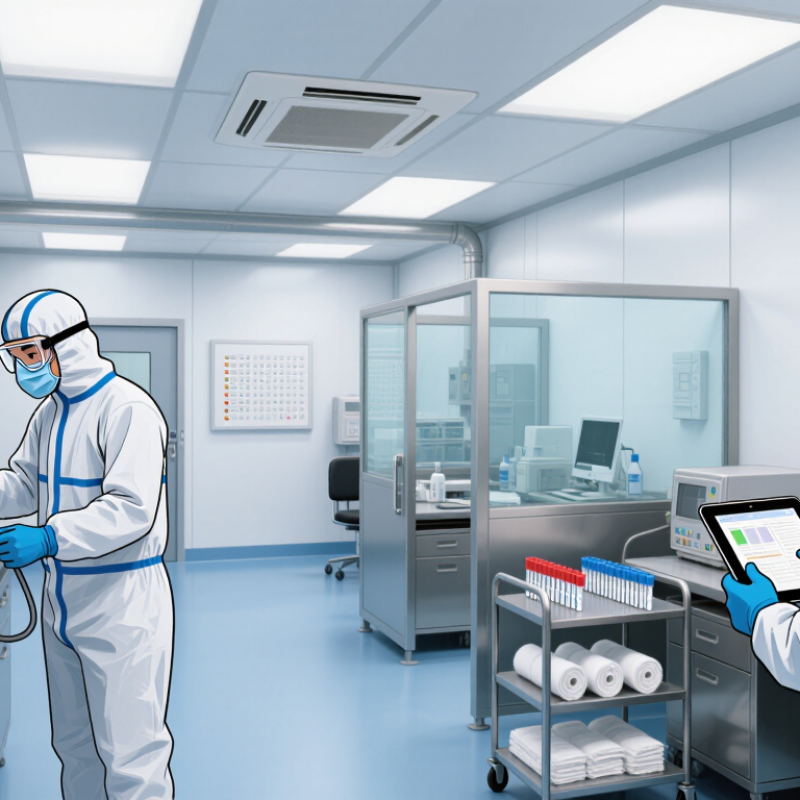
Cleanroom Disinfection Validation is the evidence-based process that shows whether a disinfection program consistently controls contamination in controlled environments. It connects cleaning procedures, disinfectant selection, contact time, surface compatibility, and microbiological recovery. A credible validation plan begins with the actual facility, not a generic template. Walls, floors, equipment joints, transfer hatches, and difficult-to-reach corners may require different attention.
Small details matter. Operators should record disinfectant lot numbers, preparation times, application methods, and wet contact time. Environmental monitoring results can reveal whether a procedure works during routine production, not only during a carefully managed study. Surface sampling, recovery studies, residue checks, and representative organisms can strengthen the assessment. Independent review by quality personnel also improves confidence in the final report.
Yet no validation protocol is flawless. A test coupon may not represent an aged stainless-steel surface. A laboratory challenge may miss the effect of repeated wiping, airflow, or operator fatigue. These limitations deserve clear discussion, not concealment. Practical experience often exposes gaps that a polished protocol overlooks. Keep questioning the evidence.
This guide answers common questions about study design, acceptance criteria, disinfectant rotation, neutralization, documentation, and periodic review. It also explains when revalidation may be appropriate after formulation changes, equipment replacement, or recurring environmental excursions. Reliable conclusions depend on traceable data and realistic conditions. Good validation is not paperwork alone. It is a repeatable demonstration that the cleanroom can remain under control.
What Is Cleanroom Disinfection Validation?
Cleanroom disinfection validation proves that a defined process repeatedly controls microorganisms on specified surfaces. It is more than spraying disinfectant and recording the date. The protocol should identify surface materials, contact time, concentration, application method, drying conditions, and recovery techniques. FDA’s Guidance for Industry on aseptic processing emphasizes documented cleaning, disinfection, and environmental monitoring programs. PDA Technical Report No. 70 also supports risk-based studies using representative organisms and challenging locations.
A strong study includes cleanroom-relevant isolates, not only convenient laboratory strains. Stainless steel, vinyl, and difficult corners may produce different results. USP <1072> describes quantitative suspension and surface testing for disinfectant effectiveness. EN 13697 commonly evaluates at least a 4-log bacterial reduction and a 3-log fungal reduction, depending on the claim and test design. Results should be reviewed with neutralizer controls, recovery controls, and repeated runs. A perfect-looking result can still mislead.
Tips: Map high-touch areas before testing. Confirm the true wet contact time with a timer. Include shadowed edges and equipment wheels. Keep the challenge realistic, but deliberately demanding. If recovery is poor, investigate the method before celebrating. Validation is never completely finished; airflow changes, new materials, and recurring isolates can expose weak assumptions.
Top Cleanroom Disinfection Validation Questions Answered - What Is Cleanroom Disinfection Validation?
| Validation Question | Answer | Typical Evidence or Data | Relevant Reference |
|---|---|---|---|
| What is cleanroom disinfection validation? | It is documented scientific evidence demonstrating that a defined disinfection procedure consistently reduces viable microorganisms on specified cleanroom surfaces to an acceptable level when used under approved conditions. | Approved protocol, risk assessment, test results, deviations, conclusions, and final validation report. | EU GMP Annex 1; USP <1072> |
| Is disinfection validation the same as cleaning validation? | No. Cleaning validation focuses primarily on removing product residues, process residues, and soils. Disinfection validation focuses on demonstrating microbial reduction and control on defined surfaces. | Separate acceptance criteria, sampling plans, analytical methods, and study reports. | EU GMP Annex 1; PIC/S GMP guidance |
| What is the main objective? | The objective is to show that the selected disinfectant and application method are suitable for the organisms, surfaces, contact time, concentration, and environmental conditions encountered in routine operations. | Microbial-reduction results under worst-case or representative conditions. | USP <1072>; ASTM E2197 |
| Which microorganisms should be evaluated? | The panel should be justified through risk assessment and normally include representative Gram-positive and Gram-negative bacteria, yeasts, and molds. Organisms recovered from the facility should be considered where scientifically appropriate. | Organism list, rationale, culture conditions, inoculum levels, and recovery results. | USP <1072>; ISO 14698-1 |
| How is disinfectant effectiveness commonly expressed? | Effectiveness is commonly expressed as a logarithmic reduction in viable microbial count. A 1-log reduction equals 90%, 2-log equals 99%, and 3-log equals 99.9% reduction, subject to the method and study design. | Log10 reduction calculations comparing controls with treated samples. | ASTM E2315; ASTM E2197 |
| What surfaces should be tested? | Testing should represent surfaces routinely disinfected, such as stainless steel, coated walls, floors, ceilings, glass, plastics, and other materials that may affect disinfectant performance. | Surface material, finish, roughness, porosity, location, and compatibility observations. | USP <1072>; ISO 14644-5 |
| Why is contact time important? | The surface must remain visibly wet for the validated contact time. Allowing the disinfectant to dry too early can reduce microbial efficacy and makes the procedure inconsistent with the validated condition. | Wet-contact-time study, application instructions, and operator observation records. | Disinfectant label instructions; USP <1072> |
| What controls are required? | Controls should demonstrate the starting microbial level and confirm that the neutralization and recovery methods are valid. Neutralizer controls are important because disinfectant carryover can suppress microbial growth and create false results. | Untreated controls, neutralizer efficacy controls, neutralizer toxicity controls, and recovery controls. | USP <1072>; ASTM E1054 |
| How should neutralization be demonstrated? | The neutralizer must stop disinfectant activity without harming the test organisms. Its suitability should be demonstrated for each relevant disinfectant, concentration, surface, and test method. | Recovery comparison with and without disinfectant exposure, including predefined recovery limits. | ASTM E1054; USP <1072> |
| What acceptance criteria should be used? | Acceptance criteria should be established before testing and justified by the facility risk assessment, intended use, microbial risk, surface type, and applicable regulatory expectations. There is no universal single criterion for every cleanroom. | Preapproved log-reduction target, recovery criteria, invalid-test rules, and deviation requirements. | EU GMP Annex 1; USP <1072> |
| Should disinfectants be rotated? | Rotation may be used as part of a contamination-control strategy, but it should be scientifically justified. Rotation alone does not replace validated efficacy, appropriate application, environmental monitoring, or investigation of adverse trends. | Rotation schedule, rationale, efficacy data, and trend reviews of environmental isolates. | EU GMP Annex 1; ISO 14698-1 |
| How are spores addressed? | If spore control is required by the process or risk assessment, a sporicidal agent or validated sporicidal step should be included. Vegetative antibacterial activity does not automatically demonstrate sporicidal activity. | Separate spore challenge data, defined exposure conditions, and documented use frequency. | USP <1072>; applicable disinfectant efficacy standards |
| What role does operator technique play? | Operator technique can directly affect coverage, pressure, wiping pattern, overlap, solution volume, and contact time. Personnel must be trained and periodically assessed against the approved procedure. | Training records, observation checklists, visual coverage studies, and qualification assessments. | EU GMP Annex 1; ISO 14644-5 |
| How is ongoing performance monitored? | Routine environmental monitoring, microbial identification, trend analysis, disinfectant preparation checks, and periodic review of deviations are used to confirm continued control after initial validation. | Surface-monitoring results, alert/action trends, organism profiles, and corrective-action records. | EU GMP Annex 1; ISO 14698-1 |
| When should revalidation be considered? | Revalidation should be considered after changes that may affect efficacy, such as a new disinfectant, changed concentration or contact time, altered surface materials, new equipment, revised procedures, adverse microbial trends, or significant facility modifications. | Change-control assessment, impact analysis, repeat testing, and updated validation documentation. | EU GMP Annex 1; quality risk-management principles |
| What should the final validation report contain? | The report should summarize the objective, scope, responsibilities, materials, methods, acceptance criteria, raw data, calculations, deviations, investigation outcomes, conclusions, and approval status. | Traceable records linking approved protocols, laboratory data, calculations, and corrective actions. | Good documentation practice; EU GMP Annex 1 |
Note: Validation protocols and acceptance criteria should be scientifically justified, risk-based, and aligned with the applicable regulatory requirements and disinfectant instructions for the intended use.
FAQS
Begin with a documented contamination risk assessment. Define rooms, surfaces, operators, equipment, disinfectants, and target organisms. Include bacteria, fungi, and resistant spores. Set measurable acceptance criteria before testing begins. The plan should also define failures, investigations, retraining, and revalidation triggers.
Particle counts measure airborne cleanliness, not microbial control. For example, a Class 5 room allows up to 3,520 particles per cubic metre at 0.5 micrometres. A Class 7 room allows up to 352,000. That distinction matters. Surface sampling, air monitoring, personnel monitoring, and visual inspection are still necessary.
Create a matrix connecting each surface with its disinfectant, concentration, contact time, and application method. Include walls, floors, equipment, seams, and difficult geometries. Record the recovery technique for every location. A smooth steel surface may behave differently from textured plastic. Do not assume one result covers every surface.
Use laboratory surface-carrier studies and controlled field verification. Small steel or polymer coupons can represent real surfaces. Apply organisms, dry them, and expose them for the stated contact time. Recover survivors and calculate the reduction. Suspension tests are useful for screening, but they may overstate practical performance.
Disinfectant residue can continue killing organisms during sampling. This may produce falsely low recovery counts. A validated neutralizer stops that carryover effect. Confirm neutralizer suitability and recovery efficiency before formal testing. Otherwise, the numbers may look better than reality.
Include dried residues, heavy soil loads, low temperatures, short contact times, and hard-to-reach areas. Test minimum contact time, not only ideal exposure. Repeated use should also be considered. Operators may miss part of a seam. That weakness deserves review.
A useful protocol often includes at least three independent runs. The exact number should reflect process risk and variability. Three runs are not magic. Operators, rooms, and surface conditions can change. More evidence may be needed when results vary or recovery counts rise.
Link the room, surface, disinfectant lot, concentration, contact time, operator, and sampling result. Keep raw files, approved protocols, deviations, investigations, and final approvals. Record timestamps and original observations. Small gaps matter. Use access controls, audit trails, version control, and tested backups.
Review trends regularly, including recurring isolates, longer recovery times, missed contact periods, and repeated deviations. Revalidation may be needed after room changes, equipment changes, or disinfectant changes. Alert limits should trigger documented assessment. Do not hide results inside annual averages. A passed validation can still need correction.
Conclusion
Cleanroom Disinfection Validation is a structured process used to confirm that cleaning and disinfection procedures consistently control microorganisms on surfaces, equipment, and other critical areas. It explains why validation is essential for maintaining cleanroom control, reducing contamination risks, protecting product quality, and supporting reliable operations. A well-designed plan should define the cleanroom zones, target organisms, disinfectants, application methods, contact times, environmental conditions, sampling locations, and acceptance criteria.
The article also outlines common approaches for evaluating disinfection effectiveness, including surface sampling, microbial recovery testing, and comparisons performed before and after treatment. Validation results should be recorded in clear, traceable documents that include protocols, test data, deviations, corrective actions, and final conclusions. Regular review, controlled updates, and periodic revalidation help ensure that the process remains effective when facilities, procedures, or operating conditions change.